
For most of our Alliance families, the One Big Beautiful Bill Act (OBBBA) has a minor impact on giving. But in 2026, we get to take $1,000 in contributions as an above-the-line deduction, or $2,000 if married filing jointly, against our taxable income. This new provision will give most folks a $120 to $400 lower tax bill if they do not itemize. All givers can avail themselves of this benefit. Above-the-line means we do not need to itemize our tax deductions to get this benefit.

But what about our giving above those thresholds, which we as Christians usually do?
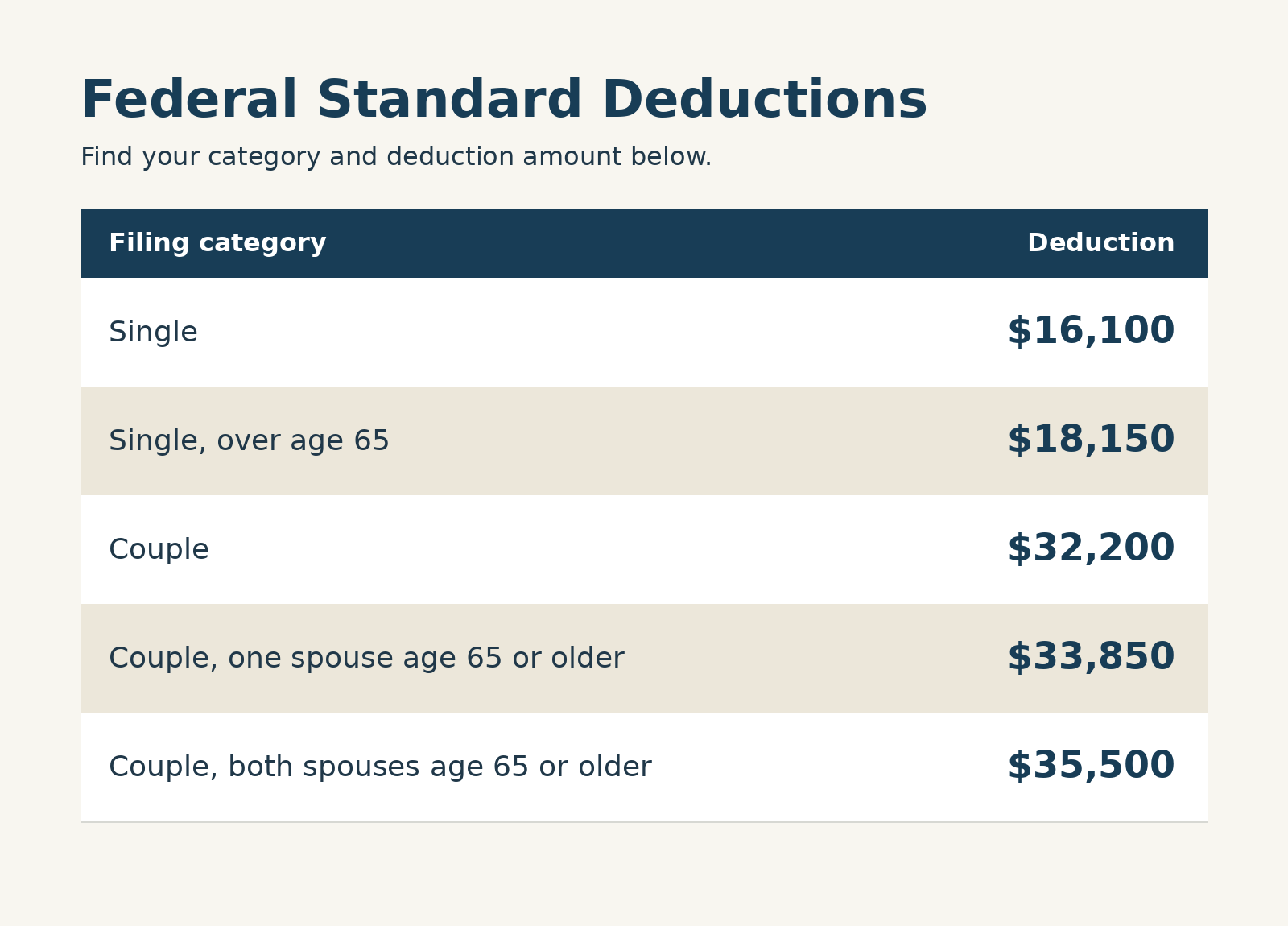
On our income tax returns, we are given a standard deduction each year as individuals and couples. See the chart below. Plus, if we are 65 or older, we have an additional deduction amount. So, in many cases, it doesn't matter how much our itemized deductions are. We still take the standard deduction because it exceeds our total itemized deductions.
Federal Standard deductions are as follows:
Is there a way we can utilize the IRS gift of the standard deduction and still get the benefit of our itemized deductions?
Yes, there is—just not in the same year.
For people who give, there is a way to adjust the timing of your gifts to increase itemized deductions in one year and use the standard deduction in another. This method is called Bunching, which is basically doubling up itemized deductions in a single year to exceed the standard deduction that year and then using the standard deduction in the other year.
Is this Bunching strategy advantageous for you?
First, you need to understand itemized deductions.
Generally, very much simplified. If state and local taxes plus interest on your home do not push you near or over the standard deduction, then Bunching may be a strategy for you.
How to maximize the utilization of your standard deduction?
The downside of Bunching is that if you're giving your church $15,000 per year, you really don't want to double your giving for one year and then give the church nothing the next year.

How to get around this downfall?
There is a tool here at Orchard Alliance called a Donor Advised Fund (DAF).
How does a DAF work?
As you come to the end of the year, you can open a DAF at Orchard Alliance and contribute the total amount of giving you would normally give the following year. That creates an additional charitable tax deduction for year 1. Through the DAF, you can make periodic grants to your church in the following year. Hence, the church or other charities receive their normal gifts over the two years.
Contact your friends at Orchard Alliance, and we can review how a DAF can work in your circumstances and assist you in opening a DAF for 2026.
What is the expected tax benefit?
The tax benefit depends on each person's tax circumstances, which include your tax bracket, standard deduction amount, and normal itemized deductions without contributions. Again, we are trying to achieve tax efficiency in utilizing the standard deduction.
Example: You are a married couple, and one of you is 65 or older, and the other is under age 65. Therefore, your standard deduction from our chart is $33,850. On an annual basis, your total itemized deductions, which will primarily be your state and local taxes and any home interest you may have, are $21,000, before considering your charitable deductible contributions for that year.
If your charitable deductible contributions exceed $12,850, then you can utilize that $12,850 of unused standard deduction by doubling up your contributions in Year 1 for a tax benefit for that year and using the full standard deduction or $33,850 in the next.
So, what’s the expected tax benefit? If your tax bracket is 22% and your state taxes are 5%, then your savings is 27% of the $12,850, or Federal and State tax savings of $3,470. As an estimate, that benefit is achievable every other year. This illustration is very simplistic, so call our team at Orchard Alliance to review your specific tax circumstances and determine whether this method applies.
Note: If you are 73 or over and have significant IRA funds subject to required minimum distributions, please inquire with Orchard Alliance about another tax-effective strategy called a Qualified Charitable Contribution (QCD), which comes directly from your IRA. A QCD may be more advantageous than a DAF. Or both strategies may be appropriate.
